
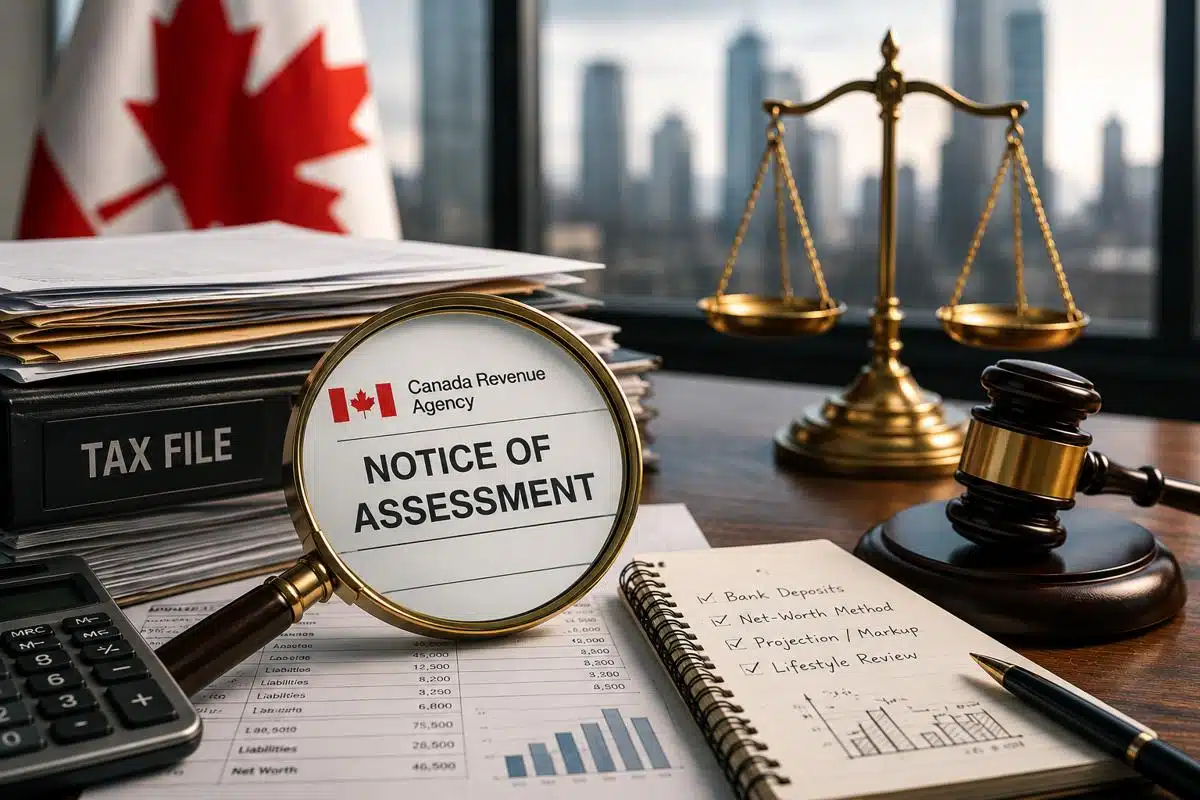
Overview: The Canada Revenue Agency’s Alternative Tax-Assessment Techniques & How to Beat Them
When the Canada Revenue Agency’s tax auditors can’t rely on your official books and records—whether it’s because they’re incomplete, disorganized, or non-existent—they don’t just shrug and move on. They use alternative tax-assessment techniques (also known as “indirect” or “arbitrary” methods) to estimate your income. Think of it as the CRA’s version of forensic reconstruction. Instead of looking at what you say you earned, the CRA’s tax auditors look at the evidence of how you lived.
Canadian courts, such as the Tax Court of Canada, Federal Court of Appeal, and Supreme Court of Canada, continue to scrutinize the assumptions and mechanics underlying the CRA’s alternative tax-assessment techniques. Recent case law demonstrates that, when represented by a knowledgeable Canadian tax-litigation lawyer who understands the logic behind these alternative tax-assessment techniques, taxpayers can successfully challenge them.
After reviewing the Canada Revenue Agency’s various alternative-tax assessment techniques, this article reveals several strategies that our expert Canadian tax-litigation lawyers have successfully employed to undermine the CRA’s analysis and reduce our clients’ tax bills.
The Canada Revenue Agency’s Alternative Tax-Assessment Techniques
Under subsection 152(7) of Canada’s Income Tax Act and subsection 299(1) of Canada’s Excise Tax Act, the CRA’s tax auditors wield the authority to assess tax regardless of the information that a taxpayer provides (or doesn’t provide). The Canada Revenue Agency’s tax auditors typically exercise this authority if the taxpayer doesn’t retain adequate records, the taxpayer’s lifestyle calls for significantly more income than what the taxpayer reported, or the CRA’s tax auditors suspect under-the-table dealings because the taxpayer runs a business in a traditionally cash-heavy industry. Indeed, the CRA invokes its most aggressive alternative tax-assessment techniques when auditing small and medium businesses—groups that the CRA’s tax auditors perceive as most likely to retain poor records or lack internal controls.
In Bousfield v the King, 2022 TCC 169, the Tax Court of Canada explained that, although the phrases “arbitrary assessment,” “alternative tax-assessment technique,” “net-worth assessment,” and “indirect income verification” are often used interchangeably, these concepts differ. The CRA typically issues an arbitrary assessment to compel a non-filing taxpayer to engage with the system. In particular, an arbitrary assessment is a tax assessment that the Canada Revenue Agency issues with little, if any, analysis, usually with the goal of prompting a taxpayer who has failed to file a tax return to do so. Alternative tax-assessment techniques, by contrast, are the methods that the Canada Revenue Agency’s tax auditors use to recalculate income where the tax auditor has rejected the amount that the taxpayer reported. A net-worth assessment is a specific type of alternative tax assessment technique. To conduct a net-worth assessment, the CRA’s tax auditors estimate a taxpayer’s allegedly unreported income by measuring changes in the taxpayer’s assets and liabilities over time and by adding the taxpayer’s personal expenditures.
Here’s a further breakdown of the Canada Revenue Agency’s favourite alternative-tax assessment techniques:
- The Bank-Deposit Method: Using the bank-deposit method, the CRA tax auditor analyzes all deposits into your bank accounts and assumes that every dollar deposited is taxable income. It is then up to the taxpayer to identify specific deposits that are non-taxable, such as bank transfers between accounts, loan proceeds, or gifts.
- The Projection Method (a.k.a. Markup Method): With this method, the Canada Revenue Agency’s tax auditors project your sales revenues on the basis of input costs and industry margins. For instance, if the CRA’s tax auditors know that your cost of goods sold (COGS) is $50,000 and the industry standard markup is 300%, they’ll project that your sales should have been $150,000. If you reported $80,000, the CRA will assess you for the difference. Tax auditors commonly use this method when auditing retail or restaurant businesses.
- The Net-Worth Method: This is the Canada Revenue Agency’s “gold standard” of alternative tax-assessment techniques. The CRA auditor calculates your total assets and liabilities at the beginning and end of a period. If your net worth grew by $100,000, but you only reported $30,000 in income, the CRA assumes the remaining $70,000 is taxable income unless you can prove it came from a non-taxable source (like an inheritance or a lottery win).
The net-worth method assumes that one can derive a taxpayer’s annual unreported income by:
- subtracting the taxpayer’s net worth at the beginning of the year from that at the end;
- adding the taxpayer’s personal expenditures during the year;
- deleting any non-taxable receipt, including loans and other debt, and any value accumulation of an existing asset during the year; and
- deducting the taxpayer’s reported income for the year.
While the rationale underlying a net-worth assessment is sound in principle, the technique too easily permits a tax auditor to aggregate the practical flaws of each other indirect method of income verification. For instance, when applying a net-worth assessment, a CRA tax auditor will often use a bank-statement analysis to derive a taxpayer’s personal expenditures and growth in net worth. When doing so, the tax auditor may err not only by mischaracterizing business-related withdrawals as personal expenditures—a common mistake when computing personal expenditures—but also by failing to correct for transfers between accounts—a common mistake with bank-deposit analysis. In addition, tax auditors often overlook liabilities incurred by the taxpayer that would offset an increase in assets.
The Tax Court of Canada has long recognized that “the net worth method of estimating income is an unsatisfactory and imprecise way of determining a taxpayer’s income for the year”: Ramey v The Queen, [1993] 2 CTC 221 at pg. 2122 (Bowman, T.C.J.). This method’s imprecision is exactly why it works to the CRA’s advantage and the taxpayer’s detriment.
All of these alternative tax-assessment technique rely on third-party information and numerous assumptions. Say you own a restaurant or night club, and the Canada Revenue Agency believes that you’ve underreported your income from alcohol sales. The CRA auditor might estimate these revenues by obtaining purchase invoices from your alcohol vendors to discern your costs, by assuming that you sold all the booze that you purchased, and by deriving your revenue on the basis of typical markups on alcohol sales. In one case handled by our knowledgeable Toronto tax lawyers, the CRA tax auditor ignored the wine used in food recipes, which resulted in grossly overestimated unreported income from alcohol sales.
Likewise, a CRA tax auditor conducting a bank-deposit analysis will obtain your account statements directly from your bank, assume the deposits consist of taxable income, and add them all up. Proper audit techniques require that the tax auditor reconcile and eliminate transfers between accounts; this often doesn’t happen. Further, unless you can satisfy the tax auditor that a particular deposit was a non-taxable item—such as a gift—the tax auditor’s assumption stands.
Successfully Disputing an Alternative Tax Assessment
Challenging the Canada Revenue Agency’s alternative tax-assessment techniques can be daunting, particularly because, in tax disputes, the burden of proof generally rests with the taxpayer. Yet recent judicial decisions illustrate several strategies that our Canadian tax-litigation lawyers have employed to undermine these tax assessments:
Tax Litigation Strategies
Tax-Litigation Strategy 1: Produce Reasonably Reliable Records; Perfection Isn’t Necessary
As discussed above, the CRA’s alternative tax-assessment techniques serve as imprecise tools for estimating a taxpayer’s income. As a result, courts frown upon their use when a more reliable method is available. Where a taxpayer maintains reasonably reliable records, courts may prefer them over the Canada Revenue Agency’s reconstruction. In Menash v The Queen, 2008 TCC 378, for instance, the Tax Court of Canada chastised a CRA tax auditor’s use of the net-worth method despite his having received an alternate analysis from the taxpayer along with the supporting information and documentation underlying the taxpayer’s analysis. The court rejected the CRA’s use of an alternative tax-assessment technique, concluding that the taxpayer’s records—despite minor errors—were more reliable than the Canada Revenue Agency’s calculations.
Tax-Litigation Strategy 2: Beat the CRA Tax Auditors at Their Own Game by Conducting Your Own Net-Worth Assessment
Taxpayers may also advance their own alternative calculations, including those that follow one of the CRA’s own alternative tax-assessment techniques, such as the net-worth method. In Dionne v The Queen, 2012 TCC 136, the taxpayer produced his own net-worth analysis, which exposed flaws in the Canada Revenue Agency’s bank-deposit analysis and persuaded the court that the CRA’s analysis had overstated the taxpayer’s income. Similarly, in Bousfield (cited above), the court rejected multiple alternative tax-assessment techniques that the CRA had employed and accepted the taxpayer’s modified approach, which, the court found, was better suited to the taxpayer’s business.
Tax-Litigation Strategy 3: Don’t Take the CRA’s Factual Assumptions for Granted
The validity of an alternative tax-assessment technique hinges more on the soundness of its underlying assumptions than on its mathematical precision. In Berezuik v The Queen, 2010 TCC 296, the Tax Court of Canada invalidated the Canada Revenue Agency’s net-worth assessment because the underlying factual assumptions were incorrect, resulting in numerous errors, such as mischaracterization of RRSP transfers as taxable income. These inaccuracies ultimately compromised the integrity of the entire assessment.
Similarly, when the Canada Revenue Agency’s tax auditors use the bank-deposit analysis, they generally assume that every bank deposit consists of taxable income. A taxpayer can disprove these assumptions by demonstrating that deposits derive from non-taxable sources such as gifts, loans, gambling winnings, or the disposition of a personal-use property. In the context of a Tax Court hearing, the taxpayer’s credible testimony may suffice on its own, despite limited documentation. In Premier Fasteners Inc. v The King, 2026 TCC 2, the Tax Court of Canada accepted credible oral testimony that a bank deposit didn’t come from a taxable source—even though the taxpayer lacked further supporting documents.
Tax-Litigation Strategy 4: Invoke the Reversed Burden of Proof if the CRA Issued a Statute-Barred Reassessment or Applied Gross-Negligence Penalties
Limitation periods act as a safeguard for taxpayers. Once a tax year is statute-barred (which typically occurs 3 years from the date of the original tax assessment), the burden of proof shifts to the CRA. In particular, before the CRA’s tax auditors can validly issue a tax assessment or tax reassessment beyond the normal reassessment period, they must demonstrate that the taxpayer made a misrepresentation attributable to neglect, carelessness, or wilful default. This reversed burden puts the CRA’s “indirect” methods, such as the net-worth method, under a microscope. In Fuhr v The King, 2024 TCC 43, the Tax Court invalidated the CRA’s statute-barred reassessments because of the tax auditor’s speculative assumptions and flawed net-worth calculations.
The Canada Revenue Agency also bears the burden of proof when assessing gross-negligence penalties. So, even if the court upholds the CRA’s use of an alternative tax-assessment technique, the court will vacate any gross-negligence penalties that tax auditors applied without warrant. In particular, to meet the burden of proof, the CRA’s tax auditors must go beyond merely pointing to unreported income. In Khanna v Canada, 2022 FCA 84, Canada’s Federal Court of Appeal confirmed that unreported income by itself doesn’t justify gross-negligence penalties.
Pro Tax Tips & Tax Guidance from Canadian Tax-Litigation Lawyers
These tax-litigation strategies often overlap, and more than one can be used against a single flaw in the CRA’s analysis. The Canada Revenue Agency’s alternative tax-assessment techniques are inherently inaccurate. But the CRA’s advantage lies in the fact that, in Canadian tax disputes, the taxpayer has the initial onus of rebutting the CRA’s assumptions. In other words, the Canada Revenue Agency benefits from the numerous assumptions required to make the alternative tax-assessment techniques workable. The assumptions underlying the Canada Revenue Agency’s alternative tax-assessment techniques frequently present a minefield of issues and are time-consuming to dispute. Still, tax jurisprudence confirms that early engagement of an expert Canadian tax-litigation lawyer, who can carefully scrutinize the CRA tax auditor’s assumptions and calculations, can yield meaningful results for taxpayers.
A taxpayer has two general options when it comes to disputing an alternative tax assessment. First, the taxpayer may challenge the propriety of the CRA tax auditor’s use of an alternative tax-assessment techniques. In this case, your basic argument is that your accounting records suffice for the Canada Revenue Agency’s tax auditor to forego an alternative tax assessment. Because of the CRA’s internal policies, this type of challenge is rarely successful at the administrative level. To pursue this approach successfully, you almost certainly need to institute tax litigation at the Tax Court of Canada.
Second, the taxpayer may challenge the alternative tax assessment by employing the tax-litigation strategies that this article discusses and by analyzing and challenging every assumption and calculation of the assessment on a line-by-line and item-by-item basis. To refute a net-worth assessment, the taxpayer’s Canadian tax-litigation lawyer, with the assistance of the taxpayer’s accountant, may conduct a detailed review of the taxpayer’s net assets and produce a net-worth analysis that counters the CRA’s alternative tax-assessment techniques.
Our professional Canadian tax-litigation lawyers have successfully opposed net-worth assessments and other alternative tax assessments by questioning every assumption, item, and interpretation made by the CRA’s tax auditors and attacking the deficiencies underlying the CRA’s alternative tax-assessment techniques.
If the Canada Revenue Agency has selected your business for a net-worth tax audit, or if the CRA’s tax auditors have decided to use one of their alternative tax-assessment techniques, contact our team of expert Canadian tax-litigation lawyers for representation, advice, preparation, and strategy.
Frequently Asked Questions
What is an alternative tax-assessment technique? And why would a CRA tax auditor use an alternative tax-assessment technique?
Alternative tax-assessment techniques are the methods that the Canada Revenue Agency’s tax auditors use to recalculate income where the tax auditor has rejected the amount that the taxpayer reported. Under subsection 152(7) of Canada’s Income Tax Act and subsection 299(1) of Canada’s Excise Tax Act, the CRA’s tax auditors wield the authority to assess tax regardless of the information that a taxpayer provides (or doesn’t provide).
The Canada Revenue Agency’s tax auditors typically exercise this authority if the taxpayer doesn’t retain adequate records, the taxpayer’s lifestyle calls for significantly more income than what the taxpayer reported, or the CRA’s tax auditors suspect under-the-table dealings because the taxpayer runs a business in a traditionally cash-heavy industry.
Indeed, the CRA invokes its most aggressive alternative tax-assessment techniques when auditing small and medium businesses—groups that the CRA’s tax auditors perceive as most likely to retain poor records or lack internal controls.
What are some examples of alternative tax-assessment techniques? How do they work?
These are some of the Canada Revenue Agency’s favourite alternative-tax assessment techniques:
- The Bank-Deposit Method: Using the bank-deposit method, the CRA tax auditor analyzes all deposits into your bank accounts and assumes that every dollar deposited is taxable income. It is then up to the taxpayer to identify specific deposits that are non-taxable, such as bank transfers between accounts, loan proceeds, or gifts.
- The Projection Method (a.k.a. Markup Method): With this method, the Canada Revenue Agency’s tax auditors project your sales revenues on the basis of input costs and industry margins. For instance, if the CRA’s tax auditors know that your cost of goods sold (COGS) is $50,000 and the industry standard markup is 300%, they’ll project that your sales should have been $150,000. If you reported $80,000, the CRA will assess you for the difference. Tax auditors commonly use this method when auditing retail or restaurant businesses.
- The Net-Worth Method: This is the Canada Revenue Agency’s “gold standard” of alternative tax-assessment techniques. The CRA auditor calculates your total assets and liabilities at the beginning and end of a period. If your net worth grew by $100,000, but you only reported $30,000 in income, the CRA assumes the remaining $70,000 is taxable income unless you can prove it came from a non-taxable source (like an inheritance or a lottery win).
All of these alternative tax-assessment technique rely on third-party information and numerous assumptions. Say you own a restaurant or night club, and the Canada Revenue Agency believes that you’ve underreported your income from alcohol sales. The CRA auditor might estimate these revenues by obtaining purchase invoices from your alcohol vendors to discern your costs, by assuming that you sold all the booze that you purchased, and by deriving your revenue on the basis of typical markups on alcohol sales. In one case handled by our knowledgeable Toronto tax lawyers, the CRA tax auditor ignored the wine used in food recipes, which resulted in grossly overestimated unreported income from alcohol sales.
The CRA is auditing my business, and the CRA tax auditor says that the CRA will do an alternative tax assessment. What should I do?
Our professional Canadian tax-litigation lawyers have successfully opposed net-worth assessments and other alternative tax assessments by questioning every assumption, item, and interpretation made by the CRA’s tax auditors and attacking the deficiencies underlying the CRA’s alternative tax-assessment techniques. If the Canada Revenue Agency has selected your business for a net-worth tax audit, or if the CRA’s tax auditors have decided to use one of their alternative tax-assessment techniques, contact our team of expert Canadian tax-litigation lawyers for representation, advice, preparation, and strategy.
DISCLAIMER: This article provides broad information. It is only accurate as of the posting date. It has not been updated and may be out-of-date. It does not give legal advice and should not be relied on as tax advice. Every tax scenario is unique to its circumstances and will differ from the instances described in the article. If you have specific legal questions, you should seek the advice of a Canadian tax lawyer.