
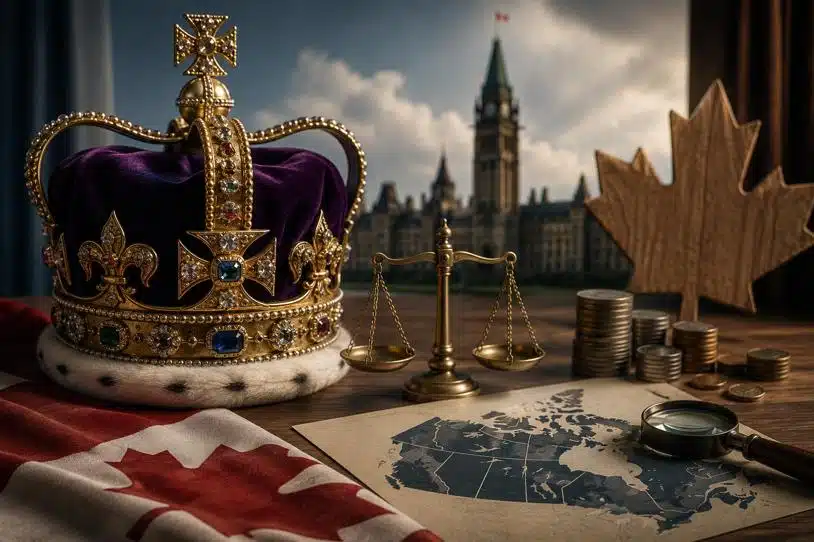
King Charles Tax Disclosure, Canadian Crown Exemptions, and Voluntary Tax Compliance: An Overview
In a development described as historically unprecedented, King Charles III has publicly disclosed the total amount of personal income tax he pays to the British government on a voluntary basis. The British monarch is not legally required to pay income or capital gains tax under United Kingdom law.
The voluntary arrangement, formalized through the Memorandum of Understanding on Royal Taxation (1993, updated 2013) and the Sovereign Grant Act 2011, has been in place since 1993 when Queen Elizabeth II first began voluntarily submitting to personal income tax obligations following significant public pressure in the wake of the Windsor Castle fire.
King Charles’s disclosure of the actual total paid goes a step further, and is reported to be the first time a reigning British monarch has made such a quantified public disclosure.
The likely lever that compelled the King to act under public pressure, this time driven by the connection of his brother, Andrew Mountbatten-Windsor, and Andrew’s connection to the Epstein Files, which so far have not only exposed a decades-long network of sexual Kompromat used to manipulate politicians and world leaders, but also a myriad of financial improprieties in the entire global banking system. As a result, many have asked questions such as: “What are we getting from the monarchy, anyway?” and “How are our lives improved by having a King in the first place?” The tax disclosure may be a tactic to placate some of these questions and criticism. Hence, the King’s push to “come clean” on his taxes.
The disclosure has attracted attention from tax practitioners and commentators in Commonwealth jurisdictions, including Canada, as it raises questions about the extent to which transparency and voluntary compliance norms applicable to a head of state translate into comparable Canadian tax law obligations. The short answer is that they do not translate directly: Canada has no constitutional tax exemption for its head of state equivalent to the British framework, and the constitutional relationship between the Crown and Canada’s tax system operates on different principles. However, the underlying themes — voluntary compliance, institutional transparency, procedural fairness, and the rule of law in tax administration — have direct resonance for Canadian taxpayers and their advisors.
This article examines the UK royal taxation framework, identifies the closest Canadian statutory equivalents, and explains why the King Charles disclosure reinforces core principles that Canadian tax lawyers rely upon in CRA audits, objections, and Tax Court litigation.
King Charles and the UK Royal Taxation Framework: Voluntary Compliance by a Monarch
Under longstanding constitutional convention and UK parliamentary practice, the reigning British monarch is not legally liable for income tax, capital gains tax, or inheritance tax on personal income and assets. The legal basis for this is not a single statutory provision but a combination of Crown immunity doctrine, parliamentary convention, and express exclusion from the scope of HMRC jurisdiction in relation to the Sovereign’s personal income.
The principal source of King Charles’s personal income is the Duchy of Lancaster, a portfolio of estates, properties, and investments that has been associated with the reigning monarch since the 14th century. The Duchy generates annual income in the range of £25–27 million (approximately CAD $43–46 million at current exchange rates). This income is not legally subject to HMRC income tax, but King Charles, following the precedent established by his mother in 1993, pays income tax on it voluntarily.
The framework is documented in the Memorandum of Understanding on Royal Taxation, a non-legislative agreement between the Palace and HM Treasury. It is renewed periodically and sets out the scope of the voluntary payment, the method of calculation, and the categories of income covered. Critically, it is not a statute and creates no legally enforceable tax obligation. The historic nature of King Charles’s 2025 disclosure is that, for the first time, the actual total paid in a given year has been publicly quantified rather than merely confirmed in principle.
Canadian Equivalents: Governor General Salary Exemption, Crown Corporations, and ITA Section 81(1)(b)
Canada does not have a constitutional tax exemption for the monarch equivalent to the UK framework. The Governor General of Canada, who serves as the monarch’s representative in Canada, does benefit from a specific targeted exemption under the Income Tax Act. Section 81(1)(b) of the ITA provides that the official salary of the Governor General is excluded from income for tax purposes. This exemption applies solely to the Governor General’s official salary earned in that capacity and does not extend to investment income, rental income, capital gains, or any other personal income, which remain fully taxable.
Canada’s Lieutenant Governors — the vice-regal representatives in each province — enjoy analogous salary exemptions at the provincial level, reinforcing the principle that the official compensation for Crown representatives discharging constitutional functions is treated differently from ordinary employment income.
A structurally closer analogue to the British Crown immunity principle is the treatment of federal and provincial Crown corporations under the ITA. Section 149(1)(d) of the ITA generally exempts from tax the income of a corporation whose shares are owned 100% by the federal Crown or a provincial Crown. This immunity reflects the longstanding principle that one level of government does not tax another — a constitutional norm rather than a policy choice. Unlike the British royal taxation framework, the Canadian Crown corporation exemption is statutory and mandatory, not voluntary.
For high-net-worth individual Canadian taxpayers, the relevance of this framework is indirect but real: there is no mechanism in Canadian law equivalent to a voluntary disclosure of total personal tax paid by a public figure. Canadian tax law, governed by section 241 of the ITA, imposes strict confidentiality on taxpayer information. Unlike the UK arrangement, where the Palace chooses to make a public disclosure, a Canadian taxpayer — including a public official — has no legal mechanism to compel or facilitate such a disclosure by the CRA. The confidentiality runs in both directions.
Tax Protester Arguments in Canada: Why They Fail and What They Cost
The King Charles disclosure may add a new rhetorical hook to the tax protester toolkit — the argument that if the monarch pays tax voluntarily, then all taxation must be voluntary. But this is only one of many specious arguments that Canadian tax protesters have advanced before the CRA and the courts over the years, all of which have been firmly and repeatedly rejected. Learn more about tax fraud and tax evasion under Canadian law, including the criminal consequences under section 239 of the ITA.
The most common Canadian tax protester arguments, and why each fails, are the following. First, the “taxation is voluntary” argument — the claim that the Income Tax Act creates no binding obligation and that filing and payment are matters of personal consent — is flatly contradicted by the plain language of the ITA, which imposes mandatory obligations on every person who is a Canadian resident or who earns Canadian-source income. Second, the “ITA is unconstitutional” argument — typically asserting that the federal income tax exceeds Parliament’s jurisdiction under the Constitution Act, 1867 — has been litigated and rejected repeatedly; section 91(3) of the Constitution Act, 1867 expressly grants Parliament the power to raise money by any mode or system of taxation. Third, the “natural person” or “common law name” argument — the assertion that a taxpayer operating under their natural name rather than a legally registered identity is not subject to statute — has no basis in Canadian law and has been treated by courts as a variant of the broader tax protester position. Fourth, the “no contract, no obligation” argument — asserting that the absence of a signed agreement between the taxpayer and the Crown means no tax liability can exist — misunderstands the nature of statute law, which operates by legislative authority rather than private contract. Fifth, the “foreign arrangement as domestic precedent” argument — of which the monarchy analogy is the latest iteration — attempts to import the constitutional arrangements of another jurisdiction as a basis for rejecting Canadian statutory obligations; no Canadian court has accepted any such argument.
The consequences of advancing these arguments are serious. Tax protesters face reassessment of all amounts claimed exempt, plus gross negligence penalties under section 163(2) of the ITA of up to 50% of the unpaid tax. Where the CRA determines that returns were filed with intent to evade tax, criminal prosecution under section 239 of the ITA can result in fines of 50% to 200% of the tax evaded and imprisonment of up to two years on summary conviction, or up to five years on indictment. In addition, the Tax Court and the Federal Court of Appeal have awarded costs against taxpayers who advance frivolous positions, compounding the financial exposure.
Canadian taxpayers who have genuine uncertainties about the scope of their tax obligations — particularly in relation to offshore income, trust arrangements, corporate structures, or cryptocurrency holdings — should obtain advice from a qualified tax lawyer rather than relying on tax protester rhetoric or analogies drawn from foreign constitutional arrangements.
Tax Transparency, Procedural Fairness, and Baker v. Canada: Implications for Canadian Tax Disputes
The King Charles disclosure, while not legally operative in Canada, reinforces a set of principles that run through Canadian tax law and litigation: that the tax system must be administered transparently, fairly, and in accordance with the rule of law. These principles have their most direct legal expression in the Supreme Court of Canada’s decision in Baker v. Canada (Minister of Citizenship and Immigration) [1999] 2 SCR 817, which established that administrative decision-makers in Canada, including CRA officers, are subject to procedural fairness obligations that require reasons to be given, affected parties to be heard, and decisions to be made in a manner proportionate to the interests at stake.
Baker is not a tax case, but its principles have been applied by the Tax Court of Canada and the Federal Court in the context of CRA audit decisions, reassessments, and the exercise of ministerial discretion under section 220(3.1) of the ITA (the taxpayer relief provision). A CRA officer who issues a reassessment without giving the taxpayer a meaningful opportunity to respond, or who fails to consider relevant representations, may be acting in violation of the Baker procedural fairness standard, which in turn can ground a judicial review application in the Federal Court.
A second relevant authority is R. v. Jarvis [2002] 3 SCR 757, in which the Supreme Court of Canada held that the CRA’s audit and investigation functions are constitutionally distinct: once the CRA’s dominant purpose in gathering information shifts from assessing tax to investigating potential criminal liability, the taxpayer’s Charter rights are engaged and CRA investigators cannot continue to use civil audit powers. The Jarvis framework establishes that even within the tax system, the Crown’s powers are bounded by constitutional constraints — a principle that aligns with the broader transparency norm illustrated by the King Charles disclosure.
Insights from a Toronto Tax Lawyer: What the King Charles Disclosure Means for Canadian Taxpayers
“The King Charles tax disclosure is symbolically significant, but Canadian taxpayers and their advisors should not overstate its legal implications. What it reinforces is a principle that underpins our own tax system: voluntary compliance works when it is supported by a framework of fairness, transparency, and proportionate enforcement. The CRA’s relationship with Canadian taxpayers is governed by the Income Tax Act, the Taxpayer Bill of Rights, and the procedural fairness principles established in Baker v. Canada. When those principles are not followed, Canadian tax lawyers have the tools to challenge CRA conduct in both the Tax Court and the Federal Court.” — David J. Rotfleisch, CPA, JD, Certified Specialist in Taxation, Rotfleisch & Samulovitch P.C.
Additional Resources from Rotfleisch & Samulovitch P.C.
Canadian taxpayers and their advisors seeking further guidance on the topics discussed in this article may wish to consult the following resources from our firm’s network of tax law publications:
- Voluntary Disclosure Program (VDP) — A Primer on Tax Evasion and How to File a Voluntary Disclosure Application (canadiantaxamnesty.ca)
- CRA Service Complaints and Procedural Fairness — How to Survive Tax Audits (taxpage.com)
- Gross Negligence Penalties — Federal Court of Appeal Overturns Tax Court’s Decision on Gross Negligence Penalties (taxlawcanada.com)
- Short-Term Rental Tax Deductions and Non-Compliance — Short-Term Rental Tax Deductions Denied in Canada (taxpage.com)
- Cross-Border Tax Compliance — A Canadian Tax Lawyer’s Guide for Digital Nomads Moving to Canada (taxlawyer.com)
- GST/HST Registration — GST/HST Registration Requirements (goodservicetax.com)
- Prediction Markets and CRA Taxation — Betting on Elections or Sports: How the CRA Taxes Prediction Markets (taxpage.com)
- Freemen on the Land, De-Taxers, and Tax Protesters — Freemen On The Land & Taxation (taxpage.com)
FAQs: King Charles Taxation, Canadian Crown Exemptions, and Voluntary Tax Compliance
Does King Charles legally have to pay income tax?
No. King Charles III is not legally required to pay income or capital gains tax under UK law. The reigning British monarch benefits from longstanding Crown immunity from direct taxation, rooted in constitutional convention and parliamentary practice. However, since 1993, the monarch has voluntarily submitted to income tax on personal income, including income derived from the Duchy of Lancaster. This voluntary arrangement is documented in the Memorandum of Understanding on Royal Taxation, a non-legislative agreement between the Palace and HM Treasury. The 2025 disclosure is reported to be the first time a reigning monarch has publicly stated the total amount of personal tax paid in a given year.
Is there a Canadian equivalent to the British Crown’s tax exemption?
Canada does not recognize a constitutional tax exemption equivalent to the British monarch’s position. The closest statutory equivalent for an individual officeholder is section 81(1)(b) of the Income Tax Act, which excludes from income the official salary of the Governor General of Canada earned in that capacity. The Lieutenant Governors of each province enjoy analogous exemptions. However, these are narrow, salary-specific exemptions — all other income earned by the Governor General or a Lieutenant Governor, including investment income, capital gains, or rental income, remains fully taxable.
At the institutional level, the ITA’s Crown corporation exemption under section 149(1)(d) is a closer structural parallel to Crown immunity: federally and provincially owned corporations are generally exempt from income tax on the basis that one level of government does not tax another. Unlike the UK framework, this exemption is statutory, mandatory, and not subject to voluntary payment.
Why is the King Charles tax disclosure considered historically significant?
The disclosure is reported to be the first time a reigning British monarch has publicly quantified the total personal income tax paid in a given year. While voluntary payment of income tax by the monarch has been in place since 1993, prior public statements confirmed the existence of the arrangement rather than disclosing the actual amount. The current disclosure goes further and is being characterized by commentators as a meaningful step toward institutional transparency.
Canadian readers should note that this characterization is based on media reporting and Palace statements. The precise legal significance of the disclosure — as distinct from its symbolic value — is limited to the UK context. It creates no legal obligation in Canada and has no direct effect on Canadian tax law.
Does Canada require public disclosure of personal tax liabilities?
No. Canada’s tax system is built on a foundation of taxpayer confidentiality. Section 241 of the Income Tax Act imposes a general prohibition on CRA employees disclosing any taxpayer information obtained in the course of administering the ITA. This confidentiality obligation applies to both the taxpayer and the CRA and cannot be unilaterally waived by either party for public disclosure purposes.
There are limited exceptions. Tax Court of Canada proceedings are public, and decisions of the Tax Court and Federal Court of Appeal are published and searchable on CanLII. The CRA also issues press releases when taxpayers have been convicted of criminal tax evasion under section 239 of the ITA. However, no mechanism exists under Canadian law for a taxpayer — even a public official — to publicly disclose total personal tax paid in the manner undertaken by King Charles.
Does the Governor General of Canada pay income tax?
The Governor General is exempt from income tax on the official salary earned in that capacity, pursuant to section 81(1)(b) of the Income Tax Act. The Governor General also receives a non-taxable expense allowance for official functions, which is distinct from the salary.
All income outside the scope of the s.81(1)(b) exemption — including investment income, capital gains, rental income, self-employment income, and any private employment or consulting income — is fully taxable on the same basis as any other Canadian resident individual. The exemption is narrow and purposive: it reflects the principle that compensation for the performance of a constitutional function should not diminish the officer’s capacity to discharge that function. It does not represent a general immunity from taxation.
Can a Canadian taxpayer argue that taxation is voluntary based on the King Charles precedent?
No. The monarchy analogy is only the latest in a long line of tax protester arguments that have been consistently rejected by Canadian courts. The voluntary nature of King Charles’s tax payments is a domestic UK arrangement flowing from UK constitutional convention and a non-legislative memorandum between the Palace and HM Treasury. It has no Canadian legal effect and cannot ground a claim that Canadian income tax is optional.
The broader Canadian tax protester repertoire includes: (1) the “taxation is voluntary” argument, asserting that the ITA creates no binding obligation; (2) the “ITA is unconstitutional” argument, claiming Parliament exceeded its jurisdiction — rejected because section 91(3) of the Constitution Act, 1867 expressly grants Parliament the power to raise money by any mode or system of taxation; (3) the “natural person” or “common law name” argument, asserting that a taxpayer operating under their natural name is not subject to statute; (4) the “no contract, no obligation” argument, asserting that the absence of a signed agreement with the Crown eliminates tax liability; and (5) various foreign-arrangement arguments, including the monarchy analogy, which attempt to import another jurisdiction’s constitutional framework as a basis for rejecting Canadian statutory obligations. None of these arguments has succeeded before the Tax Court of Canada or any appellate court.
The Tax Court of Canada and Federal Court of Appeal have consistently rejected tax protester arguments that seek to characterize the income tax obligation as voluntary, contractual, or applicable only with the taxpayer’s consent (see, e.g., Boucher v. Canada, 2004 FCA 46, where the Federal Court of Appeal dismissed a taxpayer’s claim that income tax was voluntary and that the ITA was unconstitutional, and confirmed that such positions are without merit). Taxpayers who advance such positions before the CRA or the courts face reassessment of the full tax owing plus gross negligence penalties under section 163(2) of the ITA, which can add 50% of the unpaid tax to the amount assessed. In serious cases, criminal prosecution under section 239 of the ITA is also possible.
Taxpayers with genuine questions about the scope of their tax obligations — particularly involving offshore income, trust structures, or corporate arrangements — should consult a qualified Canadian tax lawyer.
Could the King Charles disclosure influence Canadian tax transparency policy?
The disclosure may contribute to the broader international conversation about tax transparency and public trust in the tax system, but it is unlikely to directly drive legislative change in Canada in the near term.
Canada has been moving toward greater beneficial ownership transparency through the Canada Business Corporations Act amendments and provincial equivalents, which now require private corporations to maintain beneficial ownership registries accessible to law enforcement and tax authorities. The federal government’s beneficial ownership register for federally incorporated corporations became operational in 2023. These reforms are driven by anti-money laundering and tax compliance objectives, not by the royal taxation framework.
Indirectly, the King Charles disclosure reinforces the legitimacy of a public expectation that those with the highest capacity to pay — including high-net-worth individuals — should engage transparently with their tax obligations rather than seeking to obscure or minimize them. This norm is already embedded in the CRA’s compliance and audit framework, which directs enhanced scrutiny to high-net-worth individuals and their associated trusts, corporations, and international arrangements.
How is the King Charles disclosure relevant to Canadian tax litigation and CRA disputes?
The most direct relevance is indirect but important: the disclosure reinforces the principle that tax compliance, even by those with the legal capacity to avoid it, is an expression of the rule of law and institutional legitimacy. This principle has direct application in the context of CRA audits and Tax Court litigation through two foundational authorities.
First, Baker v. Canada (Minister of Citizenship and Immigration) [1999] 2 SCR 817 established that administrative decision-makers in Canada, including CRA officers, owe procedural fairness obligations to affected persons. These obligations require that taxpayers be given notice, an opportunity to respond, and reasons for decisions that affect their interests. Where the CRA fails to meet these obligations, the taxpayer may have grounds for judicial review in the Federal Court.
Second, R. v. Jarvis [2002] 3 SCR 757 established that the CRA’s audit and investigation powers are constitutionally constrained. Once the dominant purpose of a CRA inquiry shifts from civil assessment to criminal investigation, the CRA cannot continue to use civil audit compulsion powers, and the taxpayer’s Charter rights are engaged. Jarvis is a foundational protection for taxpayers facing serious CRA scrutiny.
Together, Baker and Jarvis establish that fairness and transparency in tax administration are not aspirational values — they are legally enforceable constraints on CRA conduct.
DISCLAIMER: This article provides broad information. It is only accurate as of the posting date. It has not been updated and may be out-of-date. It does not give legal advice and should not be relied on as tax advice. Every tax scenario is unique to its circumstances and will differ from the instances described in the article. If you have specific legal questions, you should seek the advice of a Canadian tax lawyer.