

U.S. cryptocurrency investors who failed to report digital-asset transactions properly may eventually have a new way to resolve past federal tax problems with the IRS. Section 502 of H.R. 10357, the Digital Asset Tax Certainty Act, proposes an IRS crypto voluntary disclosure program for eligible taxpayers with unreported crypto taxes and other past digital-asset tax violations.
H.R. 10357 is not merely a voluntary disclosure bill. It addresses transaction fees, stablecoins, accounting methods, lending, dealers and traders, charitable contributions, wash-sale and constructive-sale rules, mining and staking, broker requirements, and a proposed digital-asset voluntary disclosure program.
On September 16, 2026, the House Ways and Means Committee adopted a Chairman’s Amendment in the Nature of a Substitute and ordered H.R. 10357 favorably reported to the House by a vote of 38-5. The bill has not become law, and the proposed Digital Asset Voluntary Disclosure Program is not currently available.
H.R. 10357 Crypto Tax Amnesty: Five Key Takeaways
- Not law yet: Section 502 is proposed legislation. No Digital Asset Voluntary Disclosure Program is currently open.
- Two proposed tracks: Certified taxpayers would attest that the covered violations were not fraudulent or willful; uncertified taxpayers would not make that certification.
- Substantially different penalties: Early certified disclosures could attract 0% on the portion of the deficiency attributable to digital-asset violations that does not exceed $25,000 for each applicable taxable year, and 5% on the portion above that amount, while uncertified taxpayers would face materially higher rates.
- Different lookback periods: The proposed applicable period generally uses three years for certified taxpayers and six years for uncertified taxpayers, subject to the statutory starting-point rules.
- Current options still matter: Taxpayers discovering unreported crypto taxes today must consider procedures available under existing law rather than assuming Section 502 relief is available.
“A proposed crypto voluntary disclosure program could become extremely valuable, but taxpayers should not confuse a favorable proposal with existing law. The correct strategy today depends on what went wrong, whether the conduct was willful, what information the IRS may already possess, and which current compliance procedure fits the facts.”
– David Rotfleisch
Proposed Law, Not Current IRS Crypto Tax Relief
Committee approval is meaningful legislative progress, but it is not enactment. A taxpayer who already knows that cryptocurrency income, gains, or other transactions were omitted from prior federal tax returns cannot presently enter the Section 502 program.
The Joint Committee on Taxation’s description of the committee substitute states that the substitute replaced the introduced bill with similar language and principally changed references to the date of introduction to the specific date September 14, 2026. The substitute retained Section 502, titled “Establishment of Digital Asset Voluntary Disclosure Program.”
H.R. 9174 Started the Push for a Digital Asset Voluntary Disclosure Program
Representative Aaron Bean introduced H.R. 9174, the Digital Assets Voluntary Disclosure Program Act, on June 8, 2026. That standalone bill focused specifically on establishing a digital-asset voluntary disclosure program. H.R. 10357 later incorporated the concept into a much broader digital-asset tax package as Section 502.
The earlier H.R. 9174 proposal required Treasury to establish the program no later than 12 months after enactment. The committee substitute to H.R. 10357 generally requires eligible taxpayers to complete the required filings within 24 months after Treasury establishes the program.
Is H.R. 10357 Really a Crypto Tax Amnesty?
Although “crypto tax amnesty” is commonly used to describe the proposal, the phrase can create the wrong impression. Section 502 would not forgive the underlying federal tax. A participant would generally need to file the required amended returns, pay the additional tax and interest, pay the applicable digital-asset violation penalty, and provide information required by Treasury.
A more accurate description is a crypto-specific voluntary disclosure and penalty-relief program. Its value lies in a defined statutory route for correcting qualifying digital-asset violations, with specified penalties and protections, rather than cancellation of the underlying tax debt.
Certified and Uncertified Taxpayers: Why Willfulness Matters
The committee substitute separates eligible taxpayers into certified and uncertified categories. A certified eligible taxpayer must certify under penalty of perjury that no digital-asset violation during the applicable period was committed fraudulently or willfully. An uncertified eligible taxpayer does not make that certification and must submit an application approved by Treasury. Treasury may impose a reasonable application fee.
This classification should never be selected by looking only for the lowest penalty. The taxpayer must be able to make the certification truthfully. An experienced US tax attorney should review the taxpayer’s knowledge, reporting history, records, professional advice, and conduct before the taxpayer makes a representation concerning willfulness or fraud.
How Many Years Could the Proposed Crypto Voluntary Disclosure Cover?
The proposed lookback period differs for certified and uncertified taxpayers. Under the committee substitute, the applicable period generally begins with the later of the first taxable year affected by a digital-asset violation or the taxpayer’s first filed return during the six years preceding enactment for an uncertified eligible taxpayer, or three years for a certified eligible taxpayer. The period ends with the taxpayer’s last taxable year ending before enactment.
Certified status could therefore affect not only the penalty rate but also the number of years brought into the statutory disclosure period. The precise result would depend on the taxpayer’s filing history and affected years.
What Penalties Would Apply Under the Proposed Crypto Tax Amnesty?
For amended returns filed during the first 12 months after Treasury establishes the program, the committee substitute proposes the following penalty rates for the portion of the deficiency attributable to digital-asset violations for each applicable taxable year:
| Taxpayer category | Deficiency portion | First 12 months |
|---|---|---|
| Certified | Up to $25,000 | 0% |
| Certified | Above $25,000 | 5% |
| Uncertified | Up to $25,000 | 25% |
| Uncertified | Above $25,000 | 40% |
For amended returns filed after the first 12 months, the rates increase to 5% and 10% for certified taxpayers and 40% and 50% for uncertified taxpayers. For certified taxpayers, the threshold increases from $25,000 to $100,000. The legislation also authorizes Treasury to waive some or all of the penalty when a waiver would serve the interests of justice and proper administration of the internal revenue laws, expressly including violations attributable to reasonable cause.
Why Would a Taxpayer Use Section 502 Instead of Simply Amending Tax Returns?
An amended return may be appropriate in some cases, but filing one does not place a taxpayer in the proposed Section 502 program. Section 502 would provide a defined regime for digital-asset violations, including program penalties, specified relief from additional penalties, and particular treatment of information disclosed through the program.
For an uncertified eligible taxpayer who satisfies the remedial requirements, the committee substitute prevents further penalties under IRC sections 6662 and 6663 on properly disclosed deficiencies. It also prevents the properly disclosed information from being used to refer or prosecute the taxpayer under IRC sections 7201, 7203, or 7206, other than section 7206(2), for the properly disclosed violations. For certified taxpayers, the legislation prevents further section 6662 penalties on properly disclosed deficiencies.
I Failed to Report Cryptocurrency to the IRS. What Should I Do?
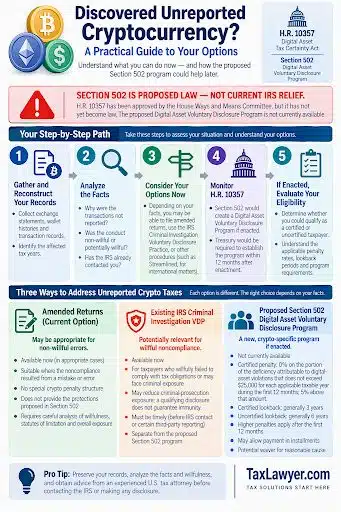
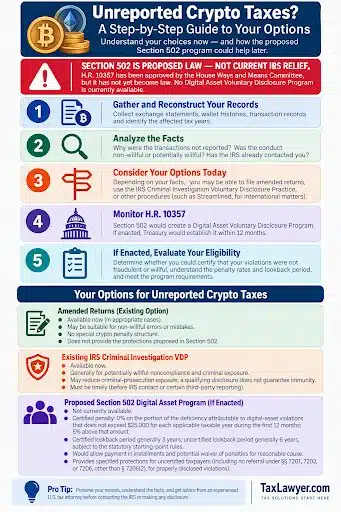
Discovering unreported cryptocurrency does not automatically determine which IRS procedure a taxpayer should use. Before filing amended returns or making a voluntary disclosure, the taxpayer should reconstruct the affected digital-asset transactions, identify the affected tax years, and quantify the potential federal tax liability. The taxpayer should also examine why the reporting failure occurred because potentially willful noncompliance raises materially different considerations from an inadvertent reporting error.
Section 502 does not currently provide relief because H.R. 10357 has not become law. Depending on the facts, currently available procedures may need to be considered instead. A taxpayer concerned about potential willfulness or criminal exposure should obtain advice from an experienced US tax attorney before approaching the IRS or making corrective filings.
Current IRS Options Versus the Proposed Section 502 Program
| Issue | Current correction procedures | Existing IRS Criminal Investigation VDP | Proposed Section 502 |
|---|---|---|---|
| Available now | Potentially, depending on the facts | Yes, for qualifying cases | No |
| Primary focus | Correcting inaccurate or delinquent filings | Willful noncompliance and potential criminal exposure | Qualifying historical digital-asset violations |
| Crypto-specific | No | No | Yes |
| Willfulness | Must be evaluated before selecting a procedure | Central to eligibility and strategy | Central to certified versus uncertified status |
| Defined Section 502 penalty schedule | No | No | Yes, if enacted |
| Can taxpayer simply wait? | Requires case-specific advice | Requires case-specific advice | The program does not yet exist |
The IRS describes its existing Criminal Investigation Voluntary Disclosure Practice as an option for taxpayers who willfully failed to comply with tax obligations or committed tax-related crimes and may face criminal exposure. Where the failure was not willful and resulted from an error or mistake, the IRS directs taxpayers to consider other options, including amended or past-due returns. Section 502 would create a third, digital-asset-specific statutory framework if enacted.
Section 502 should also be distinguished from potential administrative changes to the IRS Voluntary Disclosure Program. Those developments concern the general IRS voluntary disclosure framework, whereas Section 502 would create a statutory program specifically addressing digital-asset violations.
What If the IRS Has Already Contacted the Taxpayer?
Timing can materially affect the available options. Under the existing IRS Criminal Investigation Voluntary Disclosure Practice, a disclosure must be timely. The IRS states that timeliness can be lost after commencement of a civil examination or criminal investigation, receipt of certain third-party information, or acquisition of information connected to enforcement activity.
The proposed Section 502 program contains its own rules. An uncertified taxpayer who is subject to an ongoing criminal investigation concerning a digital-asset violation, or an ongoing IRS examination of an applicable taxable year, would need a Treasury waiver to participate. A certified taxpayer subject to an ongoing IRS examination of an applicable year would also need a waiver.
Old Cryptocurrency Transactions and Limitation Periods
Taxpayers should not assume that an old transaction can automatically be ignored merely because several years have passed. Section 502 contemplates that program liabilities may be assessed, collected, and paid notwithstanding otherwise applicable limitations rules. A taxpayer considering a future disclosure would need to compare the consequences of participation with the taxpayer’s position under current US crypto tax law, including the dates returns were filed and the limitations rules applicable to the particular facts.
Could the Proposed Program Permit Installment Payments?
The proposed remedial requirements permit immediate payment or entry into, and continued compliance with, an installment agreement under IRC section 6159 for the additional tax, interest, and applicable program penalty. This could be important where several years of transactions produce a substantial liability. It does not mean that a special Section 502 installment arrangement is presently available.
Form 1099-DA Makes Accurate Crypto Tax Reporting Increasingly Important
The proposed program arrives as federal digital-asset information reporting becomes more standardized. Form 1099-DA is used by brokers to report proceeds, and in some cases basis, from digital-asset dispositions to taxpayers and the IRS. IRS instructions state that for 2026 and later, gross-proceeds reporting is mandatory for digital assets, basis reporting is mandatory for covered securities, and basis reporting for noncovered securities may be voluntary.
The reporting obligation is broader than the form. The IRS states that taxpayers must report all income, gains, and losses from taxable digital-asset transactions whether or not they receive Form 1099-DA. The absence of a form from a foreign exchange or another platform does not eliminate the underlying federal tax-reporting obligation.
How CARF Could Expand Cross-Border Crypto Tax Information Reporting
The Crypto-Asset Reporting Framework, or CARF, is an OECD standard for the automatic exchange of information about relevant crypto-asset transactions between participating tax authorities. The United States joined a 2023 Treasury statement expressing an intent to work toward domestic implementation and exchange agreements, subject to applicable national legislative procedures. The OECD’s June 17, 2025 commitment list placed the United States among jurisdictions undertaking first CARF exchanges by 2028.
CARF is not yet a fully operative U.S. reporting regime. U.S. implementation still requires domestic measures, and more recent U.S. policy material has recommended that Treasury and the IRS consider proposing CARF regulations. CARF should therefore be distinguished from the existing Form 1099-DA broker-reporting rules, which are already being phased in under U.S. domestic law.
Future CARF exchanges could increase the cross-border crypto-asset information available to the IRS concerning U.S. taxpayers’ activity through service providers outside the United States. That development would make accurate historical reporting and timely correction of unreported crypto transactions increasingly important, particularly because prior IRS knowledge or enforcement activity can affect available disclosure options. CARF does not itself create the proposed Section 502 voluntary disclosure program, and CARF reporting would not determine whether a taxpayer qualifies for certified or uncertified treatment under Section 502.
Example: Correcting Unreported Crypto Taxes Through Voluntary Disclosure
Assume a taxpayer used several exchanges and self-custody wallets over several years and later discovered that numerous crypto-to-crypto trades and staking rewards were omitted from federal tax returns. The proper analysis does not begin by choosing the lowest proposed penalty. The taxpayer should reconstruct the transactions, identify the affected years, calculate the tax consequences, and determine why the reporting failures occurred.
If the evidence supports a truthful certification that none of the covered violations was willful or fraudulent, certified treatment could become relevant if Section 502 is enacted and the taxpayer otherwise qualifies. If the evidence does not support that certification, the taxpayer should not make it merely to obtain more favorable rates. The same amount of additional tax can produce different procedural consequences because the taxpayer’s conduct matters.
Should Taxpayers With Unreported Crypto Wait for H.R. 10357?
The possibility of favorable future legislation does not make waiting the correct strategy in every case. H.R. 10357 has advanced through committee, but the program is not law. Even if enacted, the legislation contemplates a later Treasury implementation process rather than immediate availability.
A taxpayer with known noncompliance should determine what options exist under current law, whether the conduct raises willfulness concerns, whether the IRS has already received relevant information, and whether delay could narrow the available choices.
“A taxpayer with unreported crypto should not start by asking which program produces the smallest penalty. Start by reconstructing the transactions and establishing why the reporting failure occurred. The facts determine which compliance strategy is defensible.”
– David Rotfleisch
Experienced US Tax Attorney Pro Tax Tips: Reconstruct First, Disclose Second
Preserve exchange statements, wallet histories, blockchain transaction identifiers, cost-basis records, tax documents, previously filed returns, and communications with accountants or tax preparers. Identify the affected years and quantify the federal tax issue before selecting a procedure. Just as importantly, determine why the reporting was incorrect before making any representation concerning willfulness or fraud. Until Section 502 becomes law, taxpayers should evaluate the procedures that actually exist rather than assuming that a proposed crypto tax amnesty is presently available.
Frequently Asked Questions About the Proposed IRS Crypto Tax Amnesty
Is there currently an IRS crypto tax amnesty under H.R. 10357?
No. The House Ways and Means Committee approved an amended version of H.R. 10357, but committee approval is not enactment. Section 502 does not presently provide an open Digital Asset Voluntary Disclosure Program. A taxpayer with unreported digital-asset transactions should therefore assess current correction and disclosure options rather than attempting to claim proposed relief.
Is the proposed program really a crypto tax amnesty?
Only in a colloquial sense. The proposal would not forgive the underlying federal tax. Participants would generally have to correct the affected filings and resolve the additional tax, interest, and program penalty. The principal benefit is a structured digital-asset disclosure regime with specified penalties and protections, not cancellation of the tax liability.
What happened to H.R. 9174?
H.R. 9174 was the earlier standalone Digital Assets Voluntary Disclosure Program Act. H.R. 10357 later placed the concept within a broader digital-asset tax bill as Section 502. Readers may therefore encounter both bill numbers, but Section 502 of H.R. 10357 is the proposal that advanced through the Ways and Means Committee.
How many years could the program cover?
The committee substitute generally uses a six-year lookback for uncertified taxpayers and a three-year lookback for certified taxpayers, subject to the statutory rule that the period begins with the later of the first affected year or the first filed return within the relevant pre-enactment period. The applicable period ends with the last taxable year ending before enactment. Filing history and affected years therefore matter.
Why does certified versus uncertified status matter?
The categories affect the lookback period, penalty rates, procedural requirements, and available statutory protections. Certified taxpayers must certify under penalty of perjury that no digital-asset violation during the applicable period was committed fraudulently or willfully. Uncertified taxpayers apply to Treasury and face higher proposed penalties, but the legislation provides specific restrictions on further penalties and use of properly disclosed information in specified criminal matters.
What are the proposed penalty rates?
During the first 12 months after the program is established, certified taxpayers would generally face 0% on the portion of the deficiency attributable to digital-asset violations that does not exceed $25,000 for each applicable taxable year, and 5% on the portion above that amount. Uncertified taxpayers would face 25% and 40%, respectively, using the same per-year threshold structure. Later filings would generally face higher rates, and the threshold for certified taxpayers would increase to $100,000. Treasury would also have authority to waive penalties in appropriate cases, including reasonable-cause cases.
Should a taxpayer amend old crypto returns now or wait?
There is no universal answer. An amended return may be appropriate for a non-willful error, while potentially willful conduct may require analysis of the existing IRS Criminal Investigation VDP. Section 502 is not presently available. The taxpayer should reconstruct the facts and obtain advice before deciding whether immediate correction or waiting is defensible.
What happens if the IRS contacts me first?
Prior IRS contact can materially change the analysis. The existing VDP requires a timely disclosure, and the IRS identifies examinations, investigations, and certain third-party information as events that can defeat timeliness. Under proposed Section 502, taxpayers subject to specified ongoing IRS activity may need a Treasury waiver. Prompt advice is therefore important once the IRS raises a crypto-reporting issue.
Does receiving no Form 1099-DA mean I do not have to report crypto?
No. Form 1099-DA is an information-reporting form, not the source of the tax obligation. The IRS states that taxpayers must report taxable digital-asset income, gains, and losses whether or not they receive the form. The fact that a transaction occurred through a foreign broker or did not generate Form 1099-DA does not eliminate an otherwise applicable federal tax-reporting obligation.
Could taxpayers use an installment agreement?
The proposed legislation permits immediate payment or an installment agreement under IRC section 6159, provided the taxpayer remains compliant with the agreement. That may help taxpayers facing liabilities across several years, but it is a feature of a proposed program and is not a currently available Section 502 payment option.
Would the program apply only to Bitcoin?
No. H.R. 10357 uses the broader concept of digital assets and addresses cryptocurrency, stablecoins, NFTs, mining, staking, lending, trading, and broker reporting. The proper treatment would depend on the statutory definitions and the particular asset and transaction.
What records should a taxpayer preserve?
Preserve exchange exports, wallet addresses and histories, transaction identifiers, cost-basis calculations, fiat transfer records, tax forms, previously filed returns, and communications with advisers. Those records help establish both the correct tax result and the reason the reporting failure occurred, which can be critical to a willfulness analysis.
What if the taxpayer did not know crypto-to-crypto trades were taxable?
That fact may be relevant, but it is not conclusive by itself. The analysis should examine what the taxpayer knew, the information received, how the returns were prepared, whether advice was obtained, and what occurred after the taxpayer learned of the issue. A non-willfulness conclusion should follow the factual investigation, not replace it.
Could Section 502 help someone worried about criminal exposure?
Potentially. The uncertified track includes restrictions on using properly disclosed information to refer or prosecute the taxpayer for specified federal tax offenses after the taxpayer satisfies the program requirements. Because those protections are technical and the program is not yet law, anyone concerned about criminal exposure should evaluate the existing IRS VDP and other current options with an experienced US tax attorney.
What should someone with unreported cryptocurrency do now?
First preserve and reconstruct the records. Identify the affected years, calculate the potential tax, and determine why the reporting was incorrect. Then evaluate willfulness, prior IRS contact, and the procedures available under current law. Pending Section 502 legislation can be considered as part of the strategy, but it should not be treated as an existing remedy.
Can the IRS find unreported cryptocurrency?
The IRS can receive digital-asset information from broker reporting and other compliance sources. Form 1099-DA reports digital-asset proceeds, and in some cases basis, to the taxpayer and the IRS. The absence of Form 1099-DA does not remove the reporting obligation because the IRS states that taxpayers must report taxable digital-asset income, gains, and losses whether or not they receive the form.
Whether the IRS has information about a particular historical transaction depends on the facts and available records. The fact that a transaction occurred through a foreign broker or did not generate Form 1099-DA does not eliminate an otherwise applicable federal tax-reporting obligation. The appropriate response is to reconstruct the transaction history and obtain advice before the IRS initiates contact, particularly because prior enforcement activity can affect available disclosure options.
Is CARF being implemented in the United States, and why does it matter?
The United States has made an international commitment toward CARF implementation. The OECD’s June 17, 2025 list placed the United States among jurisdictions undertaking first exchanges by 2028. A 2023 U.S. Treasury joint statement also expressed an intent to work toward domestic implementation and exchange agreements, subject to national legislative procedures.
The U.S. commitment does not mean that CARF is already a fully operative domestic reporting regime. U.S. implementation still requires domestic measures, and U.S. policymakers have recommended consideration of proposed CARF regulations. CARF is distinct from Form 1099-DA and from Section 502: Form 1099-DA is a domestic broker-reporting regime already being phased in, while Section 502 would create a proposed voluntary disclosure program. Future CARF exchanges could give the IRS additional cross-border information about U.S. taxpayers’ crypto-asset activity, increasing the importance of addressing historical reporting problems before prior IRS knowledge affects available disclosure options.
Is there a deadline for the proposed IRS crypto tax amnesty?
The first 12 months after establishment would be especially important because the proposed penalty rates are lower for taxpayers who act during that initial period. A taxpayer should not, however, treat those proposed timelines as current filing extensions or postpone dealing with an existing IRS problem solely in anticipation of enactment.
No current Section 502 deadline exists because Congress has not enacted the program and Treasury has not established it. Under the proposed framework, Treasury would generally have up to 12 months after enactment to establish the Digital Asset Voluntary Disclosure Program. Eligible taxpayers would then generally have 24 months after establishment of the program to file the required amended returns and complete the prescribed disclosure steps.
Key Takeaway: Proposed Crypto Tax Relief Is Significant, But It Is Not Yet Available
The movement from H.R. 9174 to Section 502 of H.R. 10357 shows a serious congressional effort to create a dedicated federal compliance mechanism for historical digital-asset tax violations. The committee substitute provides concrete distinctions between certified and uncertified taxpayers, different lookback periods, defined penalty rates, potential penalty waivers, and specified protections.
But the program is not yet law. Taxpayers with unreported cryptocurrency should reconstruct the transactions, quantify the tax issue, determine why the reporting failure occurred, assess willfulness, consider whether the IRS has already received relevant information, and evaluate the procedures that are currently available.
Disclaimer
This article provides broad information. It is only accurate as of the posting date. It has not been updated and may be out-of-date. It does not give legal advice and should not be relied on as tax advice. Every tax scenario is unique to its circumstances and will differ from the instances described in the article. If you have specific legal questions, you should seek the advice of an experienced US tax attorney.